 DEX screener
 charts and the blockchain trades behind them
DEX screener turns blockchain trading activity into searchable token pairs, price charts, and market statistics through its own indexer. An indexer reads blockchain records and organizes them into data that people can inspect. That makes the service useful for finding a market, understanding recent trades, and comparing activity across pools. A displayed price describes that market; the amount that a proposed swap would return also depends on its size and execution conditions.
A pair chart summarizes recorded trading activity, while a swap quote reflects the amount, route, and execution conditions of a proposed trade.
Match a search result to the intended trading pair
Searching with a token address helps identify the intended asset, while checking the network and pair resolves otherwise similar results. Suppose you are preparing to inspect a token before deciding whether to trade. The expected result is a pair containing that token on the intended network. If the result shows a different address or network, return to the search rather than carrying that mismatch into a swap.
- Confirm that the network matches the token that you intend to inspect.
- Match the token address rather than relying on its name or symbol.
- Identify the quote token, which supplies the other side of the pair.
- Check that the pair address belongs to the pool whose activity you want to examine.
- Keep wallet authorization outside this search and comparison stage.
Matching identifiers establish that the chart describes the intended market. A familiar logo alone does not establish that match. Searching by name, symbol, token address, or pair address provides different entry points into the same investigation.
Why can a chart price differ from a swap quote?
A chart describes recorded prices, whereas a swap quote estimates the output for a particular amount under available execution conditions. Multiplying a holding by the displayed price gives a valuation estimate. It does not establish that the entire holding can sell at that price. Pool liquidity, the selected route, and applicable fees affect the quoted output.
Price impact is the price change caused by the proposed trade itself. Slippage describes the difference between expected execution and the execution that actually occurs. Increasing slippage tolerance permits a wider difference; it does not add liquidity or improve the starting quote. This distinction matters when a chart looks stable but a larger proposed sale produces a substantially lower average price.
From blockchain logs to indexed trades
DEX screener uses a custom indexer to parse, analyze, and store raw blockchain logs. The resulting records support its charts and market analytics. Automated processing makes trading activity visible without a person approving each trade for display. That automation concerns market data; a token description or promotional label is a different kind of information. The presence of a chart therefore establishes that the service has data to display, not that someone has reviewed the token's merits.
Reading candles alongside transaction windows
A candlestick compresses prices within a selected interval into an opening price, a high, a low, and a closing price. The candle body shows the opening and closing prices. Its wicks extend to the interval's extremes. Longer intervals combine more activity, so a movement that dominates a short chart can occupy only part of a longer candle.
The latest candle can change while its interval remains open.
Transaction counts and volume answer different questions about that activity. A count describes how many recorded transactions fall within the relevant window; volume measures the amount traded. Repeated trading can produce substantial volume without establishing a comparable increase in distinct participants. Comparisons need matching time windows and the same pair. Otherwise, a difference may reflect the selected view rather than a change in the underlying market.
Liquidity and valuation measure different things
Liquidity concerns the assets available in a pool, while valuation multiplies a token price by a supply measure. A large valuation does not mean that a matching amount of money sits in the pool. Even the pool's displayed liquidity total cannot by itself describe the execution available for every trade size. Price impact also depends on how the pool makes that liquidity available.
DEX screener calculates fully diluted valuation as total supply minus burned supply, multiplied by price. Market capitalization can differ when the service uses a reported circulating supply. Matching market cap and fully diluted valuation therefore does not independently establish that every token circulates freely. The supply basis matters alongside the price.
What brings a new token into view?
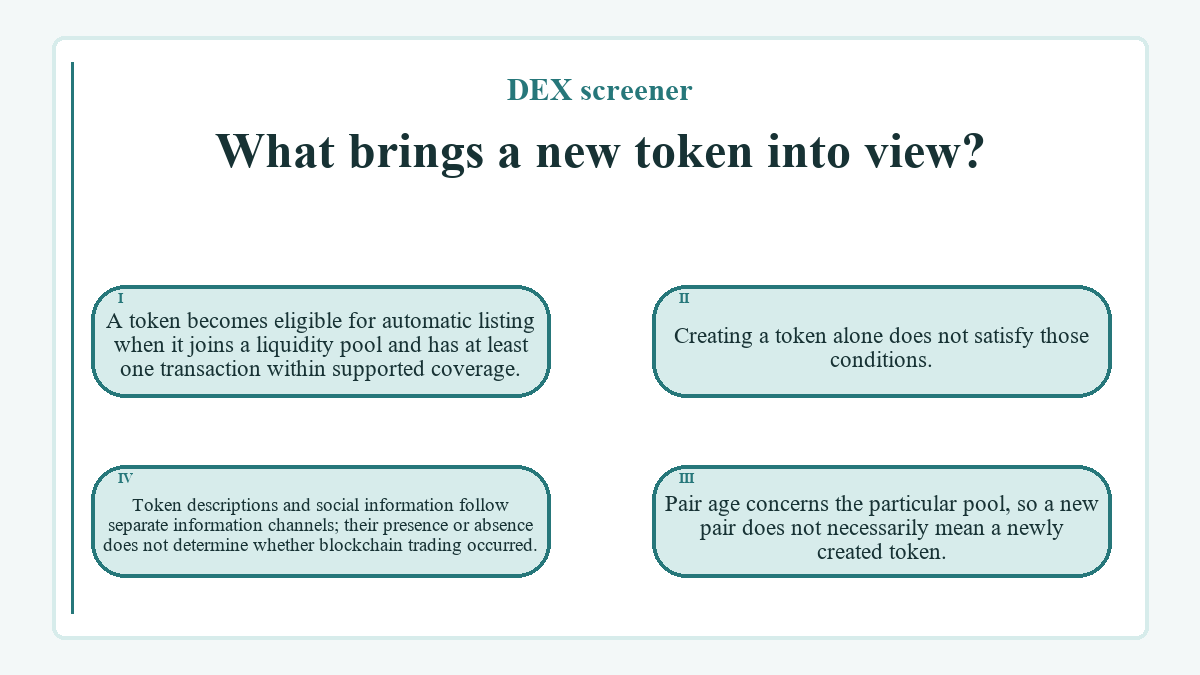
A token becomes eligible for automatic listing when it joins a liquidity pool and has at least one transaction within supported coverage. Creating a token alone does not satisfy those conditions. Pair age concerns the particular pool, so a new pair does not necessarily mean a newly created token. Token descriptions and social information follow separate information channels; their presence or absence does not determine whether blockchain trading occurred.
Filters, watchlists, and alerts organize attention
Filters narrow the displayed markets, while watchlists and alerts support continued monitoring. New-pair views focus on recently created markets. Gainers and losers emphasize price movement, and multicharts allow several charts to remain visible together. Each view answers a different browsing need; none changes the underlying trades or establishes the quality of a token.
Restrictive settings can exclude a market that would appear in a broader search. A watchlist records a selection for monitoring rather than granting the asset any special status. Likewise, an alert needs interpretation in the context of its pair and condition. A notification about price movement does not establish executable output for an order of a particular size.
Trending activity and paid visibility
Trending rankings combine market activity with engagement signals, so their order represents more than price performance. Trading volume, liquidity, and transactions contribute alongside activity on token pages. The ranking formula does not provide a transparent measure of expected returns. A token can attract attention for reasons that do not establish sustainable demand or reliable execution.
Paid Boosts can temporarily increase a token's Trending Score. Their presence describes purchased visibility, not a successful contract audit or a promise of a particular rank. Promotional emphasis should therefore remain separate from the transaction record when interpreting a busy market. A prominent token and a frequently traded token may overlap, but those descriptions answer different questions.
Can a chart prove that a token is safe?
No, a chart cannot establish whether a token's rules will allow a particular holder to sell it. Historical transactions show activity that occurred under the conditions that applied to those transactions. Token contracts can impose transfer restrictions or variable fees, and malicious implementations can prevent ordinary holders from selling. A successful purchase does not resolve those conditions. Price history is useful market evidence, but the token's transfer behavior can prevent a proposed transaction from executing.
Explorers and swap previews answer different questions
A block explorer exposes transaction records, while a swap preview estimates the result of a proposed trade. The chart organizes market activity across time. These tools complement one another because each answers a different question: what traded, what a specific transaction did, or what an intended swap may return.
Explorer details can include the transaction identifier, participating addresses, status, and recorded transfers. Those details help distinguish a completed swap from an unrelated transaction or a failed attempt. A chart movement alone cannot identify which wallet action caused it, particularly when several transactions arrive close together.
A swap preview can show the proposed input amount, output estimate, route, fees, and any applicable minimum-output constraint. Its quote may use a different pool or several pools rather than the single pair under inspection. Consequently, comparing its output with one chart requires attention to both the route and the time of the quote.
Reconcile an executed trade before closing the chart
Completion rests on the transaction's successful execution and resulting token movements, not on a chart refreshing or a wallet request disappearing. Where an approval is required, it grants spending permission; approval alone does not establish that a swap completed. Before authorizing anything, distinguish that permission from the trade and inspect the requested scope. Before submitting the swap, check that its tokens, amount, and any minimum output match what you intend to accept. After execution, the transaction record and resulting balances establish what changed. A completed blockchain trade does not reverse when the chart closes, so an unresolved display discrepancy is a reason to inspect the existing transaction before authorizing another.
Before you start with DEX screener
Can developers retrieve pair data through an API?
Developers can retrieve pair data through the public API, including searches and lookups by network and address. Responses can include price, transactions, volume, liquidity, and valuation fields. Some fields are optional or nullable, so an integration should preserve missing values rather than silently treating them as zero.
Is DEX screener available as a mobile app?
DEX screener has apps for iOS and Android. Availability of an app does not mean every browser feature appears in it; purchasing Boosts, for example, is documented as a browser function.
Does DEX screener have its own token?
DEX screener states that it does not have its own token. A token using the product's name or logo does not establish a relationship with the service.
What does a missing market-cap value mean?
A missing market-cap value means the displayed data does not provide that valuation, rather than proving a zero valuation. The API permits a null market-cap field. Price and liquidity may still be available, but a missing market-cap value does not identify which input is unavailable or why the calculation is absent.
How private is browsing token charts?
Browsing token charts can generate ordinary website usage data, including an IP address, browser information, and visited pages. Cookies and similar technologies also support tracking. Public blockchain data and browser privacy are separate matters; viewing public trades does not make the browsing session anonymous.
Do transaction counts reveal the number of individual traders?
Transaction counts do not identify how many individual people traded. One address can submit repeated transactions, and one person can control multiple addresses. Counts, address-based participation measures, and trading volume describe different aspects of activity; none alone establishes the number of independent people behind a market.
Are token descriptions taken directly from blockchain logs?
Token descriptions and social links can come from external token information lists or Enhanced Token Info. That information follows a different path from indexed trading records. A detailed profile therefore adds descriptive material without proving that the token's claims, ownership, or transfer behavior match the description.
· last updated