 DEX screener
Screener results depend on which crypto pairs satisfy the selected filters
Screener filters determine which crypto trading pairs qualify for a shortlist. The selected market sets the starting pool of candidates, while thresholds and measurement periods narrow the results. An empty list can mean that nothing satisfies the combined conditions, even when individual pairs remain searchable. To understand the result, distinguish the rules you selected from the changing values those rules evaluate, then check whether the displayed rows match the intended criteria.
Bottom line: An empty pair list can reflect restrictive settings, so compare the active conditions before treating it as missing market data.
Investigate an empty shortlist while preserving the intended scope
When a filtered list is empty, compare relaxing one condition with clearing the filters before choosing how to investigate. Relaxing one condition preserves more of the original search. Clearing everything provides a broader starting point but removes the original restrictions.
Both options should answer the same question: does the displayed list reflect the criteria currently applied? Before changing anything, note the selected network, any exchange restriction, and the active thresholds. Include each measurement period. These settings define the expected results; the number of rows alone does not establish whether the search worked.
Suppose you want to keep the selected market and investigate whether a volume minimum excludes otherwise relevant pairs. Where the filter supports adjustment, lower or remove that minimum while leaving the other conditions unchanged. With unchanged data, lowering the minimum makes pairs previously excluded solely by volume eligible only if they meet the revised minimum. Removing it eliminates that volume requirement. Newly displayed rows should still satisfy every remaining condition.
- If the intended network remains essential, retain that restriction during the comparison.
- If a volume minimum changes, compare the returned values over the same measurement period.
- If rows appear, check whether their volume explains their earlier exclusion.
- If the list stays empty, inspect another active condition rather than assuming volume caused the problem.
- If values update during the comparison, account for that change before attributing the result solely to the filter.
Matching row values to the active conditions confirms that those rows qualify. If a row fails a condition, record the specific mismatch as unresolved. A larger shortlist is not required. The minimum is an editable input; the comparison rule determines eligibility. Neither the original threshold nor a relaxed replacement establishes how a pair will perform.
Pair selection defines the eligible market
A network or exchange restriction determines which pairs enter the search before numerical conditions narrow the list further. A pair outside that selection cannot qualify merely because its trading activity exceeds a minimum. This makes market scope different from a demanding threshold: adjusting the threshold leaves the excluded market outside the search.
Pair identity also matters when several rows contain the same token. Different pools can have different counterpart assets and activity. A condition applied to one pair therefore does not describe every market for that token. Read the row at the level the filter evaluates. Treating pair-level volume as a token-wide total changes the meaning of the condition and can make apparently inconsistent results seem contradictory.
Sorting changes order, while filters change membership
Sorting places qualifying pairs in a chosen order, whereas filtering determines whether they belong in the result set. A descending volume sort puts larger values ahead of smaller values without itself imposing a minimum. A minimum-volume filter excludes values below its boundary, regardless of their relative rank. Combining the controls can make a shortlist easier to inspect. The first visible row then means the leading result under that ordering and scope, rather than a universal assessment of the token.
Thresholds combine into a narrower set
When active conditions require every rule to pass, a pair must satisfy their intersection to appear in the results. Passing the volume condition does not compensate for failing the age condition. Several individually reasonable restrictions can therefore produce a very small list when applied together.
A minimum and a maximum define opposite boundaries. Raising a minimum makes that condition stricter; lowering a maximum also makes it stricter. With unchanged data and all other conditions held constant, tightening either boundary cannot add qualifying pairs.
Check for conflicting minimum and maximum bounds. A minimum above the maximum leaves no qualifying value for that metric, even when both entries are individually valid numbers.
The comparison operator matters at the boundary. A condition that means greater than excludes equality, while greater than or equal to includes it. Read the actual operator or range description rather than inferring it from a shortened label. The threshold, unit, and operator together define the rule; a number without that context does not.
Time windows change the question being asked
A volume or price-change condition only has a clear meaning when its measurement period accompanies the value. Trading volume measures the amount traded during a specified period. A shorter window concentrates on more recent activity, while a longer window includes additional history. The same numerical threshold applied to each window asks different questions.
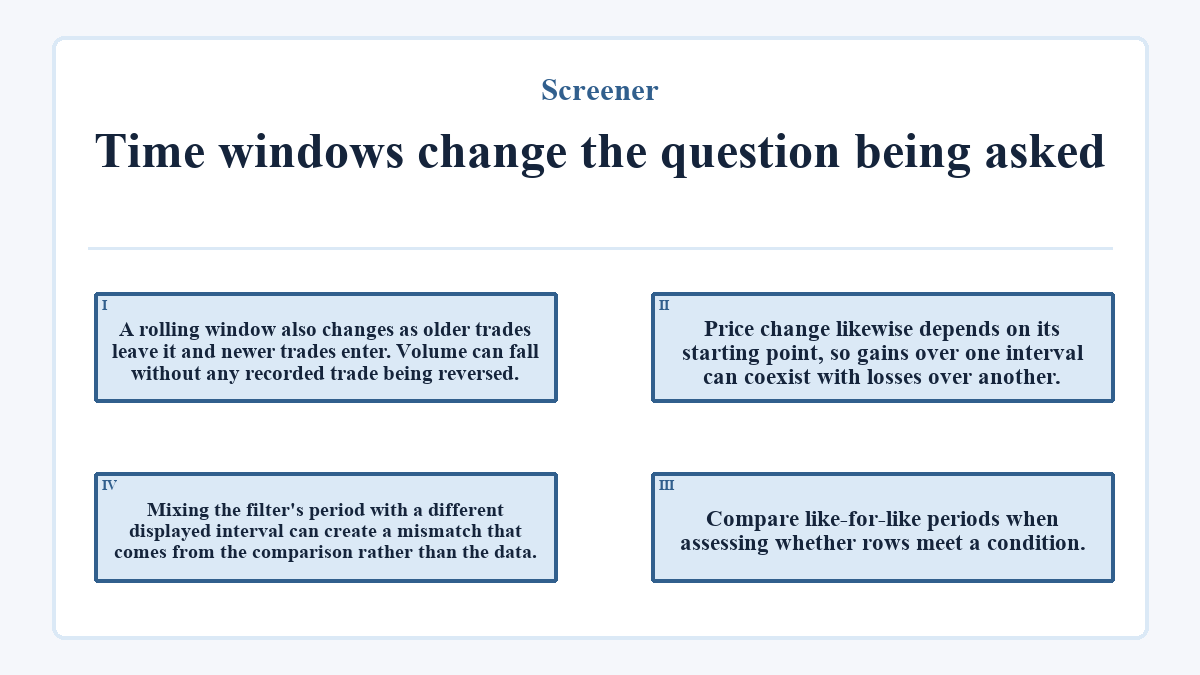
A rolling window also changes as older trades leave it and newer trades enter. Volume can fall without any recorded trade being reversed. Price change likewise depends on its starting point, so gains over one interval can coexist with losses over another. Compare like-for-like periods when assessing whether rows meet a condition. Mixing the filter's period with a different displayed interval can create a mismatch that comes from the comparison rather than the data.
Activity measures select different kinds of pairs
Volume, transaction count, and price change describe different aspects of trading, so their filters are not interchangeable. Volume measures the amount traded. Transaction count measures how many recorded trades occurred. A pair can have relatively few large trades or many small ones, producing different positions under those two measures.
Liquidity adds another distinction: it concerns funds available in a pool rather than accumulated trading activity. A volume threshold alone does not establish the liquidity available for a proposed swap. Pair age serves a different purpose again, describing elapsed time since that pair's creation. A newly created pair can contain a token that already trades elsewhere. Combining these fields should reflect the characteristics sought, rather than treating several positive-looking numbers as equivalent evidence.
Why is the filtered pair list empty?
An empty list can reflect restrictive conditions, unavailable values, or a failure to load results, and those states need different explanations. A completed search with no matches is consistent with functioning filters. A loading indicator or an explicit error does not establish that no pairs qualify. The visible state matters before interpreting the absence of rows.
Missing fields create a separate limitation. Pair data can contain an unavailable liquidity value. An unavailable value does not mean a measured value of zero. Its treatment depends on the filter implementation, so absence alone does not prove that the pair falls below the threshold. Likewise, a pair excluded from the selected market cannot appear regardless of its numerical values. These distinctions keep a narrow search result from becoming an unsupported claim about the wider market.
Live values can cross an unchanged boundary
A pair can enter or leave a filtered list even when every saved condition stays the same. The settings define a rule, while incoming data changes whether a pair satisfies it. Trading volume, price change, and liquidity can move across their respective boundaries. Age can also move a pair beyond a maximum-age condition as time passes.
Update timing affects what the screen shows at a particular moment. A displayed row represents the data available for that update, not a promise of continuing eligibility. Brief differences between views may reflect separate update times. Persistent disagreement requires comparing the same pair, field, period, and unit before concluding that the filtering rule is inconsistent.
Preserve the settings that explain the shortlist
A reusable screen needs enough configuration detail to reproduce the question, even when later results contain different pairs. Record the market scope, field names, operators, thresholds, and measurement periods. Keep sorting separate from eligibility conditions. This makes the intended search understandable without relying on a preset name such as a broad activity label.
Where saved screens are available, their purpose is to retain configuration for reuse. A saved configuration and a captured result list serve different purposes: the former describes what to search for, while the latter records what appeared at a particular time. Comparing old and new lists without their settings can hide an accidental scope change. Comparing settings without considering updated data can make ordinary market movement look like a configuration failure.
Strict filtering and broad ranking serve different searches
Strict filtering suits a search with explicit exclusion rules, while broad ranking suits a search that tolerates more manual review. A hard minimum removes every pair below it, including pairs close to the boundary. Sorting the broader set preserves those rows and changes their position. The choice concerns whether falling short should exclude a pair or merely place it lower.
These approaches impose different review costs. A tightly defined list reduces the number of rows to inspect but can hide relevant near-matches. A broader ranked list retains more context but requires additional comparison. Choose the approach that matches the intended question, and keep its interpretation consistent: meeting a threshold establishes that the recorded value passes that rule; ranking highly establishes a position among the included results.
Helpful answers about Screener
-
Can rounded values make a pair appear to violate a filter?
- Rounding can make a displayed value look equal to a threshold even when the underlying value differs. If filtering uses more precision than the table displays, an apparently identical number may fall just above or below the boundary. Equality also depends on whether the operator includes the boundary.
-
Does changing the display currency also change a volume threshold?
- A display-currency change does not by itself establish that the filter's unit changed. Currency-denominated volume and token-denominated volume measure the same activity in different units. Read the unit attached to the active condition before comparing its threshold with a column that uses another denomination.
-
Will adding a pair to a watchlist make it pass my filters?
- Watchlist membership alone does not satisfy a numerical condition. A manually retained pair can remain useful to follow even when its activity falls outside a screening rule. If a tool supports screening within a watchlist, membership defines the candidate set and the active conditions still determine which candidates qualify.
-
Do saved filter settings automatically create alerts?
- Saving filter settings does not establish that an alert is active. Alert support, eligible conditions, and activation requirements depend on the tool. A reusable search configuration describes the desired results; notification behavior requires its own supported setup.
-
Is the chart interval always the interval used by a filter?
- The chart interval and a filter's measurement period can be separate settings. A chart controls how displayed price bars group activity, while a screening field may use its own specified window. The period attached to the active filter determines which measurement belongs in the threshold comparison.
-
How should I interpret an exported shortlist after market values change?
- An exported shortlist records the results captured for that export, rather than continuing proof that those pairs qualify. Preserve its capture time and relevant settings when comparing it with a later screen. Changes in membership can reflect updated values even when the filtering conditions remain identical.
· last updated